
We are independent LR partners. Product links lead to our own product pages, and orders are placed in the official LR shop.
No cream, oil or lotion can remove stretch marks. Stretch marks are small scars in the deeper layer of the skin, and they usually fade from red or purple to pale silver over months or years whether or not you treat them. Creams can keep the skin moisturised, supple and more comfortable while it changes, and medical options such as retinoid creams, laser or microneedling can make some marks less visible, but none of them is guaranteed to make them disappear completely.
This article gives an honest overview of what stretch marks are, why they appear, what everyday creams can and cannot do, which dermatology treatments exist and how to look after your skin during pregnancy and growth spurts.
In short
- Stretch marks, called striae in medical language, form when the skin is stretched faster than its elastic fibres can adapt.
- They are very common in pregnancy, during growth spurts in the teenage years and after rapid weight gain or loss.
- Mayo Clinic states that there is no strong evidence that rubbing creams, oils or lotions prevents or treats stretch marks.
- Most stretch marks fade over time, but they rarely vanish completely.
- Retinoid creams, light and laser treatments and microneedling can help some marks fade, and retinoids should not be used in pregnancy or while breastfeeding.
What are stretch marks?
Stretch marks are narrow, slightly indented streaks on the skin. Mayo Clinic describes them as most common on the tummy, breasts, hips, buttocks and thighs, and sometimes on the upper arms. New marks can look pink, red, blue, purple or dark brown, depending on your skin tone, and over time they usually become lighter and flatter.
They are not painful or harmful. For most people the concern is purely about how they look, which is perfectly understandable, especially after pregnancy, when the body has already changed in many ways at once.
Why do stretch marks appear?
Stretch marks form when the skin is stretched. How visible they become depends on your genes and on how much and how quickly the skin is stretched. Mayo Clinic also mentions cortisol, a hormone produced by the adrenal glands, which weakens the elastic fibres in the skin.
According to Mayo Clinic, the following factors make stretch marks more likely:
- being female, and having a personal or family history of stretch marks;
- pregnancy, especially at a young age;
- rapid growth during the teenage years;
- rapid weight gain or weight loss;
- using corticosteroid medicines;
- breast enlargement surgery;
- certain conditions such as Cushing syndrome or Marfan syndrome.
Can creams really remove stretch marks?
This is where honesty matters most, because the market for stretch mark creams is full of big promises. Mayo Clinic states that the idea that rubbing creams, oils or lotions prevents or treats stretch marks is not supported by strong evidence. It adds that over-the-counter products with cocoa butter, vitamin E or glycolic acid are not harmful but probably will not help much.
So why use a cream at all? Because skin that is being stretched often feels dry, tight and itchy, particularly on a growing bump. Regular moisturising keeps the skin supple and more comfortable, the daily massage can be a pleasant moment of calm, and well-cared-for skin simply feels better. Those are good reasons to use a body lotion, as long as you do not expect it to erase marks that have already formed.
What can a dermatologist do for stretch marks?
If stretch marks really bother you, the options with the best evidence are medical. The table summarises what Mayo Clinic lists. In the UK these are usually cosmetic treatments that you would arrange privately, so ask about cost, number of sessions and realistic results before you commit.
| Option | What it does | Things to know |
|---|---|---|
| Everyday moisturiser | Keeps skin supple and comfortable | Does not remove marks; useful for itching and dryness. |
| Retinoid cream (prescription, such as tretinoin) | May improve marks less than a few months old by supporting collagen rebuilding | Can irritate the skin; not for use in pregnancy or while breastfeeding. |
| Light and laser therapies | Aim to stimulate collagen or elasticity | Several sessions; a specialist chooses the type for your skin. |
| Microneedling | Fine needles stimulate collagen in the skin | Lower risk of colour change than laser, so often preferred for darker skin. |
Mayo Clinic notes that no single treatment has proven consistently better than the others, and that treatments may help marks fade without making them disappear entirely. Newer, redder marks tend to respond better than older, silvery ones.
How can you care for your skin during pregnancy?
Pregnancy is the time when most people first think about stretch marks. A few gentle habits keep the skin comfortable without making unrealistic promises:
- Moisturise your tummy, breasts, hips and thighs once or twice a day, ideally after a warm shower while the skin is still slightly damp.
- Keep weight gain steady and in line with your midwife’s advice, because fast changes put more strain on the skin.
- Drink enough fluids and eat a varied diet, which supports your general health and your baby’s.
- Ask your midwife or pharmacist before using any product that claims to treat or prevent stretch marks, and avoid retinoid products altogether.
- Wear soft, breathable clothing that does not rub on itchy skin.
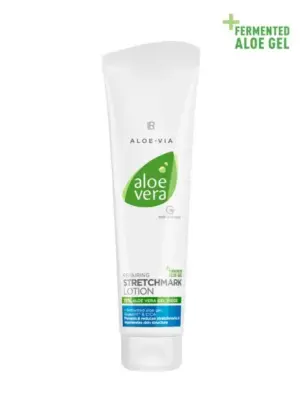
For this kind of daily care we like the LR Aloe Vera Repairing Stretchmark Lotion. It is a body lotion made for areas where the skin is under tension, such as the bump, hips and thighs, and it moisturises and cares for the skin during pregnancy, growth spurts or weight changes. It cannot remove existing stretch marks, and we would not trust any product that says it can. Check the ingredient list with your midwife if you are pregnant and unsure. Other lotions and creams are in our aloe vera skincare category, and our article on gifts for new mums has more ideas for the first weeks after birth.
The lotion we mention in this article is here:
When should you see a doctor?
Most stretch marks need no medical care. Speak to your GP if:
- stretch marks appear over large areas of your body without an obvious reason such as pregnancy or weight change;
- you have new, wide, dark purple marks together with weight gain around the tummy and face, thin skin that bruises easily or muscle weakness, which can point to too much cortisol;
- you use steroid creams or tablets and notice new marks;
- the marks are affecting your mood or self-confidence and you would like to discuss treatment.
During pregnancy, severe itching, especially on the palms of the hands and the soles of the feet, should always be reported to your midwife or maternity unit straight away, as it needs a blood test rather than more cream.
Frequently asked questions
Do stretch marks ever go away on their own?
They usually fade a great deal over months and years, becoming lighter and flatter. Mayo Clinic notes that they tend to fade with or without treatment but rarely disappear completely.
Can men get stretch marks?
Yes. Teenage boys often get them during growth spurts, and men can develop them after rapid weight gain or quick muscle growth, especially on the shoulders and upper arms.
Is coconut oil or cocoa butter better than a lotion?
Oils and butters moisturise the skin, but there is no strong evidence that they work better than an ordinary moisturiser for stretch marks. Choose the texture you enjoy using every day.
Can I use self-tan or make-up to cover stretch marks?
Yes, body make-up and self-tan can make marks less noticeable, although pale, silvery marks may not take colour in the same way as the surrounding skin. Test a small area first.
Sources
This article is general information and not medical advice. We are independent LR partners and do not speak for LR Health & Beauty.